
Home Mission Model Evidence Resources Training Our Work News About Login Contact Us
Home/ Evidence
Evidence & Research

A robust, decades-deep evidence base for whole-person recovery

In a variety of randomized and non-randomized trials, MISSION has been shown to be successful for a myriad of populations — including criminal justice-involved veterans, female offenders returning to the community, and veteran and non-veteran clients who have experienced homelessness.
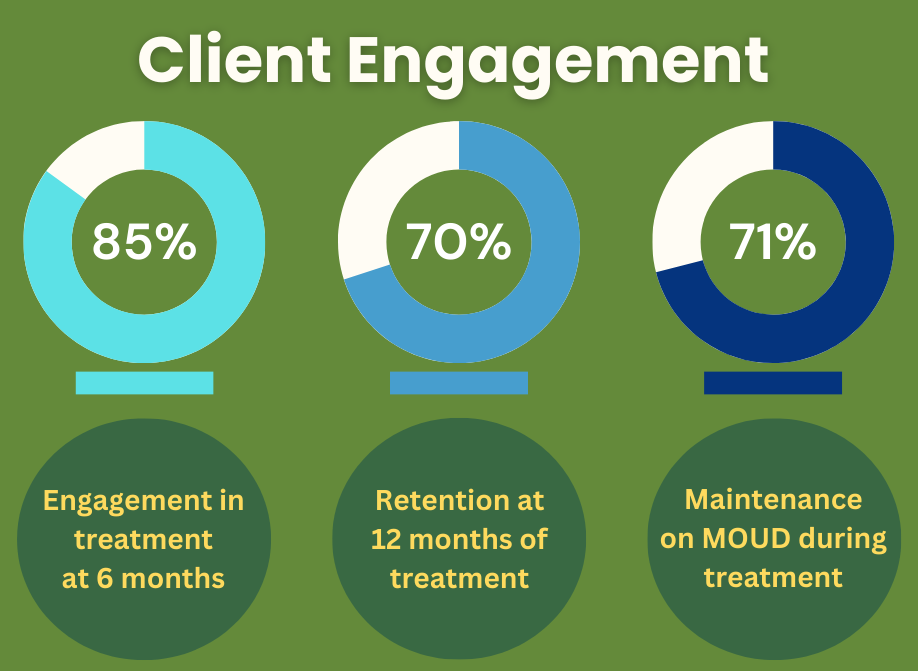
MISSION client engagement and treatment-retention data
Efficacy & Outcomes

Better outcomes across the domains that matter most

Previous studies examining the efficacy of the MISSION approach have shown improved outcomes across the areas that most affect a person's ability to recover and stay in the community:

Substance use & psychological functioning
Improved substance use outcomes and global psychiatric functioning across trials with veteran and non-veteran populations.
Housing & employment maintenance
Gains in housing stability and employment maintenance for people experiencing homelessness and co-occurring disorders.
Treatment retention & service use
Stronger treatment retention and greater use of outpatient services — keeping clients engaged with the care they need.

MISSION's efficacy has been documented for criminal justice-involved veterans, female offenders returning to the community, and veteran and non-veteran clients who have experienced homelessness.
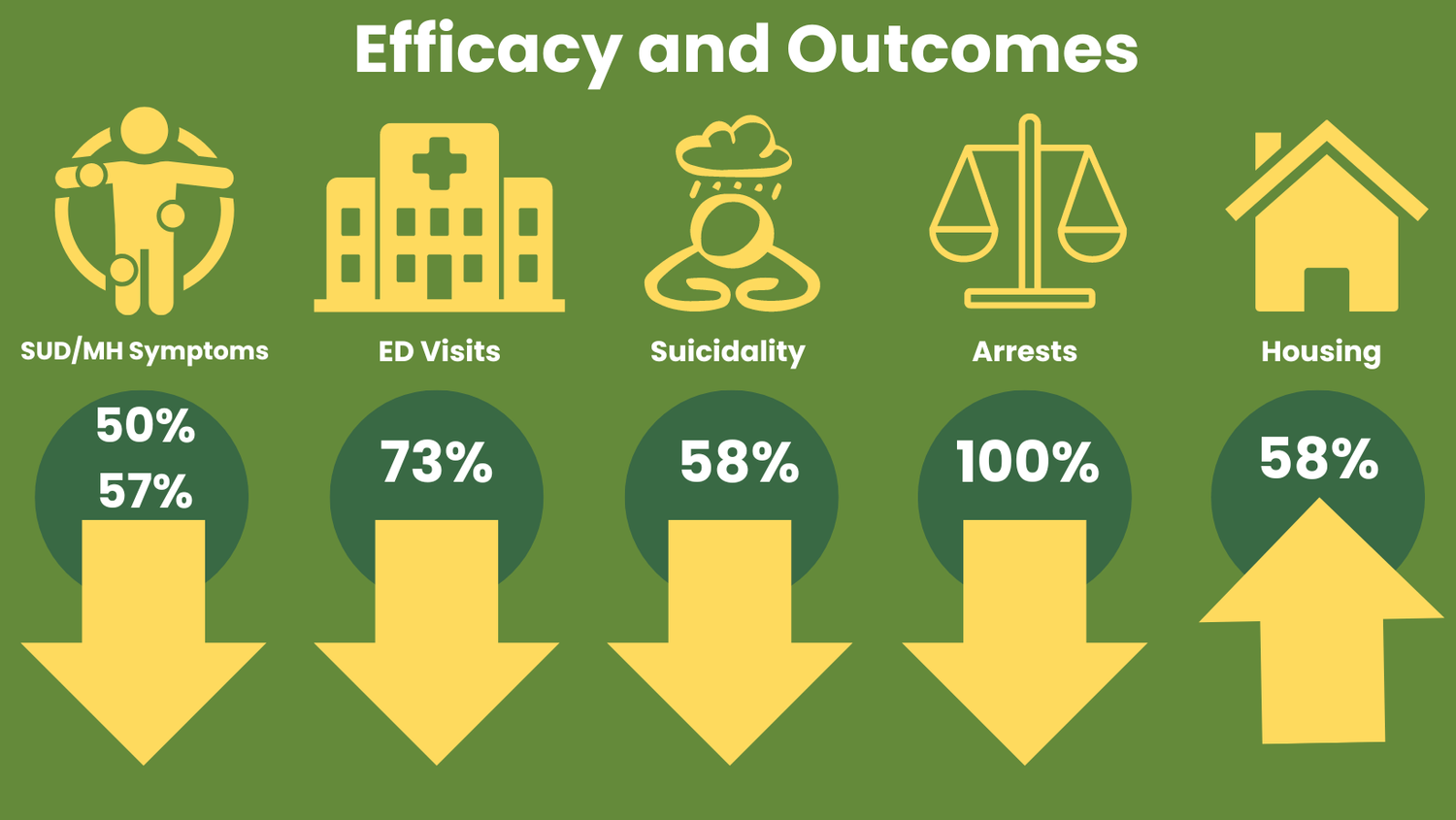
MISSION efficacy and outcomes data panel
A Whole Health Approach

Recognized by the National Institutes of Health

"A Whole Health Approach for Treating Opioid Addiction and Mental Illness — seeking sustainable models of integrated care."

The way we identify and treat mental health, substance use, and pain remains fragmented, even though these conditions have always been intimately connected. Effective treatment often combines several components: medications, peer support, group therapy, and links to community services such as food banks, housing services, employment counseling, and educational training.

Because this type of care can be difficult to access, scientists funded by the NIH Helping to End Addiction Long-term® (HEAL) Initiative are optimizing it by breaking the treatment into parts and testing different combinations that may be effective and could be covered by insurance.
Read the NIH feature

NIH HEAL Initiative — Helping to End Addiction Long-term
National Recognition

A model trusted at the national level

MISSION's evidence base has earned recognition and funding from the country's leading health and justice agencies.

SAMHSA NREPP listing

MISSION-Vet is included in the Substance Abuse and Mental Health Services Administration (SAMHSA) National Registry of Evidence-based Programs and Practices (NREPP) to address co-occurring disorders among homeless individuals.

NIH · VA · CDC-funded research

The MISSION model is backed by research funding from the National Institutes of Health, the Department of Veterans Affairs, and the Centers for Disease Control and Prevention.

Adopted into national & state plans

Deployed within the Veterans Health Administration as part of the national plan to end veteran homelessness, utilized in a Massachusetts statewide plan to end homelessness, and written into public law for delivery alongside veteran treatment courts in Massachusetts.

Listed in the PEW Results First Clearinghouse Database

MISSION is listed in The Pew Charitable Trusts' Results First Clearinghouse Database, which aggregates program ratings from leading national registries, including SAMHSA's NREPP. Enter "MISSION" into the search box to see the full listing.

View the PEW Clearinghouse

Research Findings

Published work on MISSION treatment outcomes

A selection from the chronological list of peer-reviewed studies on MISSION treatment outcomes and related findings, spanning 2005 to 2023. Each links to the published article.

2005
Preliminary Outcomes from a Community Linkage Intervention for Individuals with Co-Occurring Substance Abuse and Serious Mental Illness
Smelson, D. A., et al. — Journal of Dual Diagnosis, 1(3), 47–59.
Read more
2007
A brief community linkage intervention for veterans with a persistent mental illness and a co-occurring substance abuse disorder
Smelson, D. A., et al. — European Journal of Psychiatry, 21(2), 143–152.
Read more
2010
A Brief Treatment Engagement Intervention for Individuals with Co-occurring Mental Illness and Substance Use Disorders: Results of a Randomized Clinical Trial
Smelson, D., et al. — Community Mental Health Journal, 48(2), 127–132.
Read more
2013
A wraparound treatment engagement intervention for homeless veterans with co-occurring disorders
Smelson, D. A., et al. — Psychological Services, 10(2), 161–167.
Read more
2015
An Alternative to Incarceration: Co-Occurring Disorders Treatment Intervention for Justice-Involved Veterans
Smelson, D. A., et al. — World Medical and Health Policy, 7(4), 329–348.
Read more
2015
A cluster randomized Hybrid Type III trial testing an implementation support strategy to facilitate the use of an evidence-based practice in VA homeless programs
Smelson, D. A., et al. — Implementation Science, 10.
Read more
2016
Integrating Permanent Supportive Housing and Co-Occurring Disorders Treatment for Individuals who are Homeless
Smelson, D. A., et al. — Journal of Dual Diagnosis, 12(2), 193–201.
Read more
2018
An evidence-based co-occurring disorder intervention in VA homeless programs: Outcomes from a hybrid III trial
Smelson, D.A., et al. — BMC Health Services Research, 18, 332.
Read more
2019
Integrating a co-occurring disorders intervention in drug courts: An open pilot trial
Smelson, D., et al. — Community Mental Health Journal, 55(2), 222–231.
Read more
2019
Implementation of MISSION-Criminal Justice in a treatment court: Preliminary outcomes among individuals with co-occurring disorders
Pinals, D.A., et al. — Psychiatric Services, 70(11), 1044–1048.
Read more
2019
Impact of peer specialist services on residential stability and behavioral health status among formerly homeless veterans with co-occurring conditions
Ellison, M.L., et al. — Medical Care.
Read more
2021
Engaging Vulnerable Populations in Drug Treatment Court: Six Month Outcomes from a Co-Occurring Disorder Wraparound Intervention
Shaffer, P.M., et al. — International Journal of Law and Psychiatry.
Read more
2021
Trauma-Related Differences in Socio-Emotional Functioning Predict Housing and Employment Outcomes in Homeless Veterans
Macia, K. S., et al. — Social Science & Medicine, 114096.
Read more
2021
Digital Health Interventions for Mental Health, Substance Use, and Co-Occurring Disorders in the Criminal Justice Population: A Scoping Review
Leach, R., et al. — Frontiers in Psychiatry.
Read more
2022
A randomized controlled trial of moral reconation therapy to reduce risk for criminal recidivism among justice-involved adults in mental health residential treatment
Blonigen, D. M., et al. — Journal of Consulting and Clinical Psychology.
Read more
2023
Examining Perceived Coercion in Drug Treatment Courts
Bruzios, K. E., et al. — International Journal of Offender Therapy and Comparative Criminology, 67(1), 53–65.
Read more
2023
Community reentry: Racial/ethnic differences in unmet needs among adults with co-occurring opioid use and mental health disorder
Gaba, A., et al. — International Journal of Law and Psychiatry, 91, 101924.
Read more

Bring evidence-based, whole-person care to your community

Interested in implementing MISSION, billing for services, or partnering on research? Our team will help you get started.