
Manuals, guides, and toolkits to deliver MISSION
Model-specific treatment manuals, consumer workbooks, practical guides, and supplemental toolkits — built to help providers implement MISSION with fidelity and better serve individuals with co-occurring disorders.
A MISSION recovery companion in your pocket
We're building a mobile companion for the MISSION model — daily check-ins, guided modules, progress tracking, and one-tap crisis support. Here's an early preview of the experience.
A 9-question wellness check takes under two minutes and builds a longitudinal picture of recovery.
Streak calendars, score trends, and check-in history make progress visible and motivating.
One-tap 988 Lifeline access and direct care-team contact, always within reach.
Free, ready-to-use tools for providers and clinicians
Practical, real-world resources informed by deep clinical and billing expertise — built to help providers deliver and sustain MISSION services.
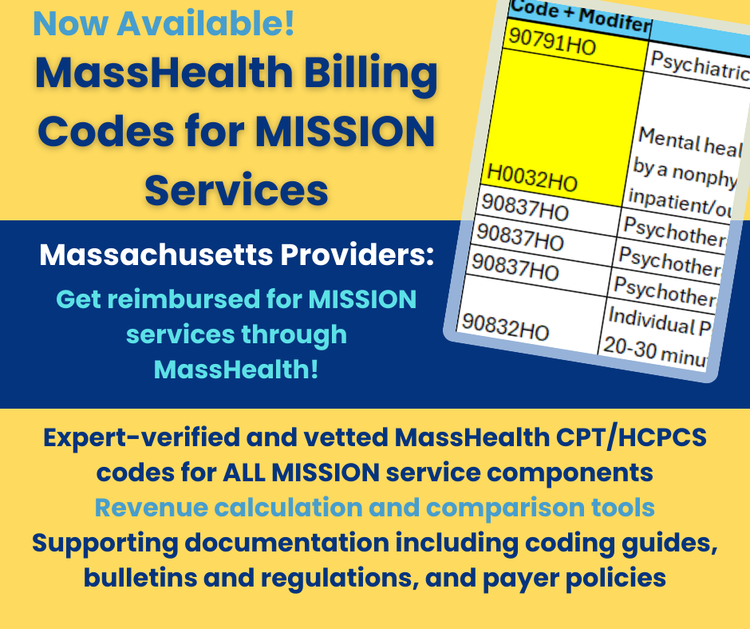
MISSION MassHealth Reimbursement Toolkit
All the relevant MassHealth billing codes, service descriptions, duration guidance, unit rates, and modifiers needed to get reimbursed for MISSION services — plus a tool for modeling services and revenue, and the related coding guides, regulations, and payer policies. A free, must-have resource for Massachusetts providers.
Download the toolkit →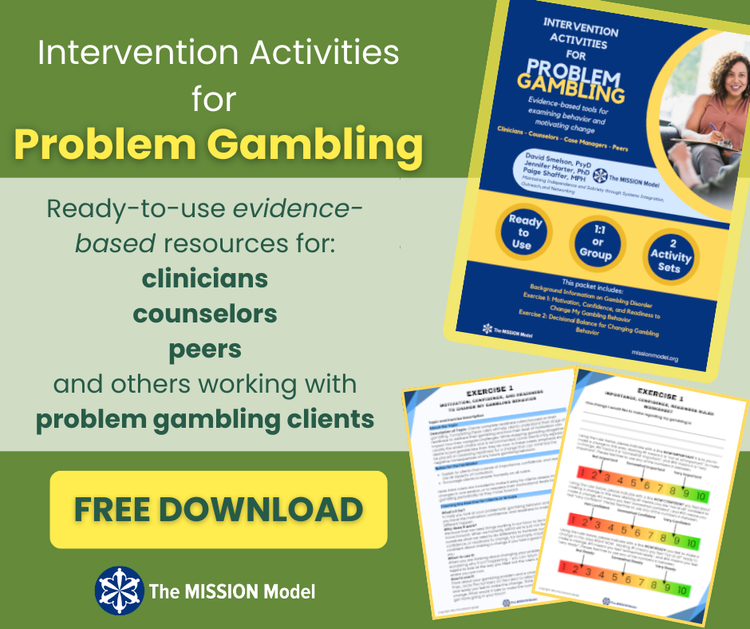
Gambling Disorder Intervention Packet
A free packet of two no-prep, ready-to-use tools that help clients examine their gambling behavior and build motivation for change — a readiness-to-change exercise and a decisional-balance worksheet, plus background information on gambling disorder.
Download the packet →Model-specific treatment manuals and consumer workbooks
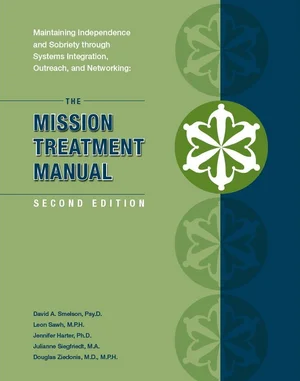
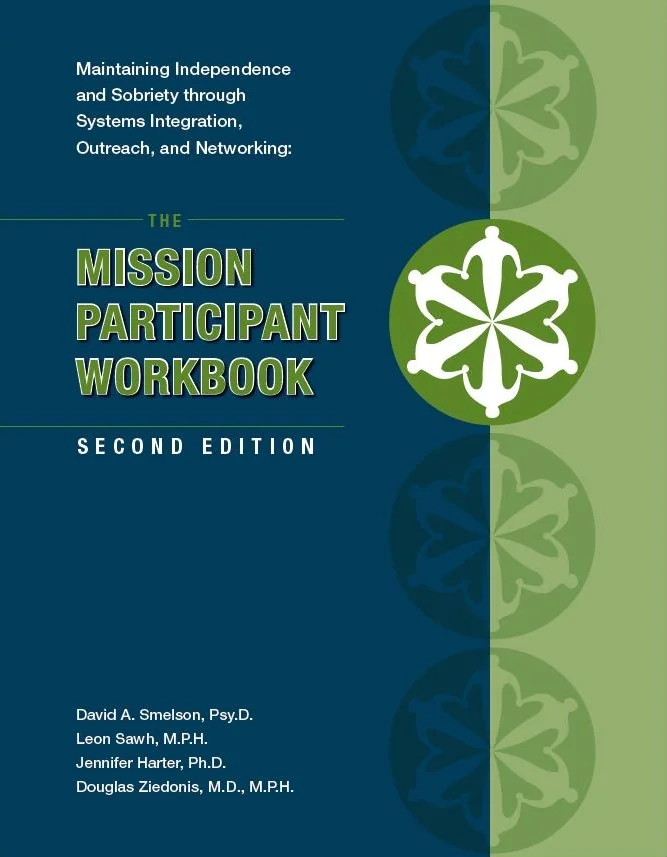
To effectively implement MISSION and maintain program fidelity, model-specific treatment manuals and consumer workbooks have been created. Each treatment manual is a comprehensive how-to guide for case managers, peer support specialists, and program administrators; each consumer workbook contains exercises and readings that assist participants in achieving their recovery goals.
MISSION — Working with Homeless Participants
The original MISSION treatment approach provides case management, peer support, integrated mental health and substance use treatment, and vocational support to homeless clients with co-occurring psychiatric and substance use disorders (CODs). Now in their second edition, these manuals and workbooks are best suited to individuals working to obtain stable housing and employment while addressing their co-occurring disorders. The participant workbook has been translated for Spanish-speaking consumers.
Access the manual & workbooks →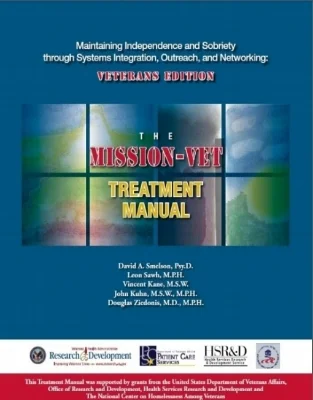
MISSION-Vet — Working with Veteran Participants
MISSION-Vet includes the same core components as the original MISSION treatment approach, but it also incorporates additional trauma-informed care procedures to meet the needs of military veterans struggling with co-occurring disorders and homelessness.
Access the manual & workbook →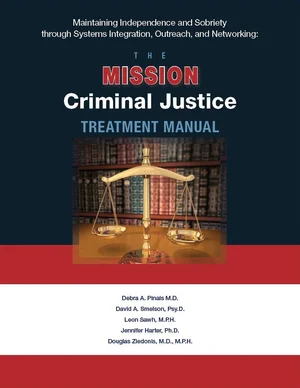
MISSION-CJ — Working with Criminal Justice-Involved Participants
MISSION-Criminal Justice (MISSION-CJ) modifies the prior MISSION treatment approaches by incorporating the risk-need-responsivity (RNR) paradigm to facilitate treatment, enabling providers to examine and address the specific criminogenic needs of their clients. The goal is to provide effective COD treatment, establish linkages with community health providers and support systems, and ultimately reduce recidivism. The workbook has been translated for Spanish-speaking consumers.
Access the manual & workbook →
Condensed handbooks for case managers and peer support specialists
In response to feedback from MISSION providers, we developed model-specific guides for case managers and peer support specialists. These guides are not intended to replace the three MISSION treatment manuals, but instead highlight the key roles and responsibilities of the case manager and peer positions respectively. They also cover service delivery components and useful tools needed to implement MISSION successfully, with corresponding manual page numbers provided within each guide to facilitate ease of use.
Strategies that enhance MISSION service delivery
The MISSION supplemental toolkits offer effective strategies to providers and systems for enhancing service delivery to better serve individuals with co-occurring disorders. They do not substitute, but rather enhance the use of the MISSION manuals and workbooks. If you are not a current MISSION provider but would like to view a toolkit, please contact us.
SSI/SSDI Outreach, Access, and Recovery (SOAR)
It can be challenging for individuals with CODs to gain access to Supplemental Social Security Income / Social Security Disability Insurance (SSI/SSDI) benefits. The MISSION SOAR toolkit helps providers learn how to increase access to SSI/SSDI benefits for their clients.
Launch the toolkit →
Peer Support
One of the three core evidence-based components of MISSION is peer support, which helps participants achieve sobriety and mental health stability through support from someone with lived experience. This toolkit details the roles and responsibilities of peer support specialists and peer navigators, includes instruction for other clinical professionals, and provides best-practice guidelines for integrating peer support into the MISSION treatment plan.
Launch the toolkit →
Family and Social Support
Family support can play a significant role in helping MISSION clients achieve their goals. This toolkit provides an overview of the clinical strategies and tools used to assess clients' support networks, explains how to increase motivation and engagement with positive family and social support, and embeds psycho-educational resources to help family members understand the issues their loved ones may be experiencing.
Launch the toolkit →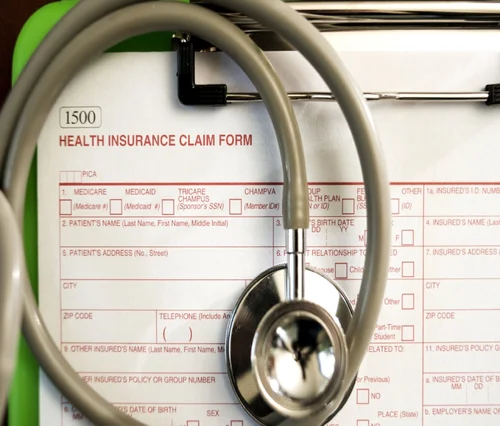
Benefits and Entitlements
An important need for all MISSION clients is to have benefits and entitlements in place. Clients may be eligible for a broad array of benefits, but applying can be a confusing process for staff and clients alike. The goal of this kit is to provide important information and suggestions to help MISSION staff guide their clients through the myriad of application processes.
Launch the toolkit →
Integrated Primary Care
Integrated primary care is vital to addressing the healthcare needs of individuals experiencing homelessness with co-occurring mental health and substance use problems. This module was developed as a practical guide for MISSION teams and administrators on how integrated care is incorporated into the MISSION model.
Launch the toolkit →
Boundaries
The relationship between Peer Support Specialists (PSS) and the MISSION clients they support can be complex and multi-layered. This toolkit was developed to enhance Peer Support Specialists' and Recovery Coaches' understanding of boundaries and the need for them — to maximize the effectiveness of support services and prevent boundary violations that could harm both the person served and the PSS or Recovery Coach.
Launch the toolkit →MISSION resources for problem gambling
The MISSION Behavioral Health Lab at UMass Chan Medical School supports the Harvard Medical School-affiliated Cambridge Health Alliance (CHA), Division on Addiction initiative for the annual Gambling Disorder Screening Day — expanding access to screening and resources for people who may have gambling-related problems. Year-round, we are committed to supporting organizations like the DOA/CHA to expand access to, and awareness of, screening for gambling disorder.